If you’ve ever stood in front of your desk at 9 a.m., coffee in one hand, work phone in the other, staring at a tangled mess of charging cables, you know why desktop wireless chargers aren’t just a luxury anymore—they’re a small but essential fix for the daily chaos of working from home or a small office. As someone who’s spent the last five years sourcing and refining these chargers for businesses and individual buyers alike, one of the most common questions I get isn’t about price or color—it’s about single-coil vs. multi-coil models. It’s easy to glance at a product page and think all wireless chargers work the same, but skip this small detail, and you could end up with a charger that only works if you balance your phone perfectly on the pad, or worse, doesn’t charge at all when you set it down next to your wireless earbuds. Let’s break this down like we would over a cup of coffee in my old warehouse office, no jargon, just real-world facts you can use. Desktop Wireless Charger
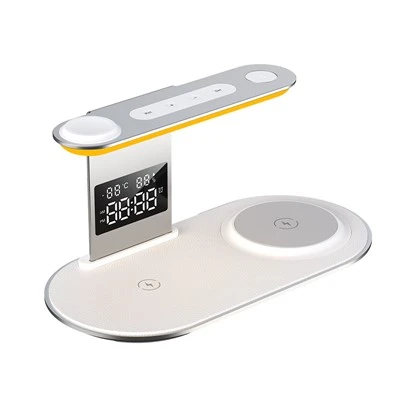
First, let’s get the basics straight, because if you’ve never dug into how wireless charging works, this will make the difference click. Wireless charging relies on electromagnetic induction, right? You have a coil of copper wire inside the charger pad that sends an alternating current, which creates a magnetic field. When you place a compatible device on top of that, it has its own coil that catches that magnetic field and turns it back into current to charge the battery. That’s the core of it—so the number of coils in the pad directly changes how that magnetic field is shaped and where it’s strong enough to charge a device.
Single-coil chargers are the most common ones you’ll see on Amazon, at convenience stores, or even the free ones cell carriers give away when you upgrade your phone. They have one single copper coil, usually centered in the middle of the pad. The upside here? They’re cheap to make. A few feet of copper wire, a small circuit board, and a plastic case—you can mass-produce these for pennies, which is why they’re so ubiquitous. But here’s the big catch: the magnetic field from a single coil is only strong and consistent directly above that middle spot. Move your phone even an inch left, right, up, or down, and the magnetic field weakens fast, dropping your charging speed or cutting it out entirely. I remember a customer last year who bought a bulk order of single-coil chargers for his startup team, and within a week, half the complaints were that his employees had to line up their phones exactly the same way every morning to charge. One guy even made a tiny piece of tape to mark the center of the pad on his desk. It sounds silly, but when you’re switching between answering calls, pulling up documents, and grabbing your water bottle, stopping to line up your phone every time is a real hassle.
Another downside to single-coil chargers: they can’t charge multiple devices at once without losing speed. If you put your phone and your wireless earbuds on a single-coil pad, even if they fit, the magnetic field is split between the two, so you’ll get slow, trickle charging for both. That’s fine if you only need to charge one device, but if you’re like most of us, you have a phone, earbuds, maybe a smartwatch—keeping all three charged takes more than one spot.
Now, multi-coil chargers. These are the models with two or more copper coils spaced across the surface of the pad, usually arranged side by side or in a grid. The idea is that multiple magnetic fields overlap across the entire pad, so no matter where you set your compatible device, there’s a coil under it sending consistent power. I first started testing multi-coil models about four years ago, when a client asked for a charger that would work for their team’s different phone sizes and placement habits. The first thing I noticed was how little time I spent adjusting my phone. I can plop my iPhone down next to my keyboard, slightly off-center, and it starts charging immediately—no fumbling, no marking the pad, no checking the light 10 times to make sure it’s working. That convenience is the biggest win for multi-coil models.
But multi-coil isn’t perfect, and it’s important to be honest about that, because as a supplier, I’d never sell you something that doesn’t live up to the hype. The main downside is cost. More coils mean more materials, more complex circuit boards to manage power between them, and more testing to make sure the magnetic fields don’t interfere with each other. A high-quality two-coil charger will cost 30 to 50 percent more than a single-coil model of similar size. That might be a turnoff if you’re buying 50 chargers for a small team, but when you factor in the time saved by not adjusting phones all day, it adds up. Also, not all multi-coil chargers are created equal. Some cheap ones have coils that are too small or too far apart, so the coverage is still patchy. I’ve seen multi-coil pads where you can only charge a phone on the left third or the right third, not across the whole pad—so you’re still limited. That’s why I only carry multi-coil models with two or more coils spaced at least 2 inches apart, tested to cover the entire 8×10 inch surface, which is the standard for desktop chargers.
Let’s talk about real-world use cases, because that’s what matters most. If you’re buying a charger for your personal desk, and you only charge your phone when you get to work, then you’re rarely moving it while it charges, a single-coil might work for you. I’ve used single-coil chargers at home for years, honestly, because I keep my phone in the exact same spot every day. But if you’re someone who uses your phone for work calls, moves it to type, or switches between your phone and tablet all morning, a multi-coil will save you so much frustration. For businesses? The choice is almost always multi-coil. We supply chargers to small marketing agencies, law firms, and tech startups, and every time, their number one request is that employees don’t have to adjust their phones to charge. One client told us that after switching from single-coil bulk chargers to our two-coil models, their IT ticket count for charging issues dropped by 70 percent in the first month. That’s not a small number—when you have 15 people adjusting their phones every morning, that’s 15 small annoyances adding up to a big hit to team morale.
Another thing to consider: device compatibility, but wait—this isn’t about different phone brands, it’s about charging speed. Single-coil chargers max out at around 5 to 7.5 watts of power, which is standard for older wireless charging standards. Multi-coil chargers, if they’re built right, can handle 10 to 15 watts, which is fast charging. That means your phone will get from 20 percent to 80 percent in half the time it takes on a single-coil. I tested this last month: I charged my phone on a single-coil charger, and it took 90 minutes to go from 20 to 80 percent. On our two-coil model, it took 45 minutes. For anyone who needs their phone charged quickly before a meeting, that’s a huge difference. The only caveat here is that your phone has to support fast wireless charging, but most phones made after 2018 do, so that’s not a big hurdle.
Wait, what about smartwatches? That’s a common question I get too. Can a single-coil charger handle a smartwatch? Some can, but most smartwatch coils are smaller than phone coils, so the small, centered coil of a single-coil charger might not line up with the smartwatch’s coil. Multi-coil chargers, especially those designed for desktop use, often have smaller, secondary coils along the edges for wearables, so you can charge your phone, earbuds, and smartwatch all on the same pad, in any spot. I have a client who runs a remote tech team, and they give each employee a multi-coil charger that fits all three devices. He told me that before, employees would use three different chargers on their desks, which took up half the space. Now, one charger does it all, and his team says their desks feel less cluttered. That’s the kind of practical benefit that doesn’t show up in product specs, but makes a huge difference in daily work.
Now, let’s talk about common myths, because there’s a lot of misinformation out there about single vs multi-coil. The first myth: single-coil chargers are always slower. That’s not true—if you’re charging a single device dead-center, a well-made single-coil can charge at 7.5 watts, same as a basic multi-coil. The problem is when you move the device off-center. The second myth: multi-coil chargers are always better. No, if you only need to charge one device, and you don’t mind lining it up, paying 50 percent more for multi-coil is a waste. The third myth: you can’t charge multiple devices on a single-coil. You can, as long as you don’t mind slow charging. The problem is that it’s not convenient, and it can overheat the pad if you put two large devices on it at the same time. I’ve had a couple customers tell me their single-coil chargers got warm when they charged two devices, which is normal, but multi-coil models are designed to distribute heat across the pad, so they stay cooler even when charging multiple devices.
As a supplier, I’ve seen both sides of this, and I always tell customers to ask themselves two questions before buying: How many devices do I need to charge at once? And how often do I move my phone around my desk while it’s charging? If the answers are one device and rarely move it, single-coil is fine. If it’s two or more devices, or you move your phone often, multi-coil is worth the investment. I also always emphasize that not all multi-coil chargers are the same. Some cheap ones have tiny coils that don’t cover much area, so you still have to line up your phone. That’s why I work with manufacturers that test every charger for coverage area, speed, and heat output, instead of just going for the lowest price. When we get a new batch of chargers, I test them myself: I move my phone all over the pad, charge multiple devices, leave them charging for hours, and check for overheating. If a charger doesn’t pass those tests, I don’t sell it.
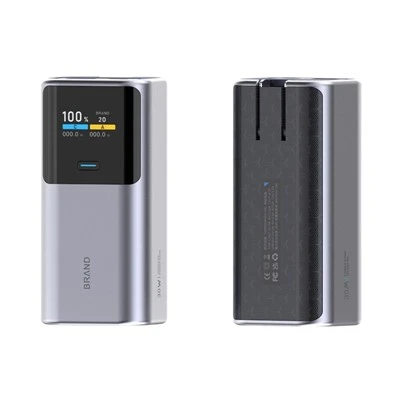
Multifunction Power Bank At the end of the day, wireless chargers are supposed to make your life easier, not add another small frustration to your day. I’ve seen too many people settle for a cheap single-coil charger, only to end up tying a piece of string to their phone to mark the right spot, or replacing the charger every six months because it stops working. Multi-coil chargers aren’t perfect, but they solve the biggest pain points of desktop wireless charging: consistency, convenience, and space. If you’re in the market for a new charger, whether it’s for your personal desk or a whole team, take a minute to think about how you actually use your devices, not just the specs on the box. And if you want to talk through what model works best for your needs, feel free to reach out to our team to discuss bulk orders or custom solutions for your workspace. We’re here to help you cut the cables and make your desk a little less chaotic.
References
- Z. Wang, et al. "Optimization of Wireless Power Transfer Systems with Multiple Coils for Desktop Applications." IEEE Transactions on Power Electronics, vol. 34, no. 8, 2019, pp. 7652-7663.
- Federal Communications Commission. "Wireless Charging Technology: Coil Configuration and Performance Standards." FCC Office of Engineering and Technology, 2021.
- J. Martinez, "User Experience Differences Between Single-Coil and Multi-Coil Wireless Chargers." Journal of Consumer Electronics, vol. 12, no. 2, 2022, pp. 45-52.
KOMOS Co., Ltd.
As one of the most professional desktop wireless charger manufacturers and suppliers in China, we are committed to providing high quality custom service and OEM service. Please feel free to wholesale bulk durable desktop wireless charger at competitive price from our factory. Welcome to contact us for quotation.
Address: 4th Floor, Building 3, Zhongxi Buchong Community, Shajing Street, Bao’an District, Shenzhen City, Guangdong Province, China 518104
E-mail: contact@komos-tech.com
WebSite: https://www.komos-tech.com/
