Hey guys, let’s cut to the chase—if you run a robot paint plant (or even just supply gear for one), you know how easy it is to fixate on the flashy stuff: the robotic arms with 10 axes, the color-matching software that locks in a perfect matte blue, the conveyor lines that move parts so smooth they look like they’re gliding. But here’s a secret from someone who’s been supplying robot paint plant kit for 12 years: 9 out of 10 plant owners I’ve worked with underbuy, under-spec, or straight-up sleep on drying ovens. That’s not a flex—It’s a costly mistake that kills yield, wastes paint, and even breaks robots before their time. Let’s break down exactly why those ovens aren’t just a box you stick parts in after spraying. Robot Paint Plant

First, let’s ground this in how robot paint plants actually work, no jargon fluff. When a robot’s spray gun lays down that thin, uniform coat—whether it’s automotive body panels, appliance frames, or motorcycle components—what you see right then is a “wet” paint film. It’s not cured. It’s just sitting on the surface, vulnerable to smudges, dust, even tiny air bubbles that get trapped if you move the part too soon. A drying oven’s job isn’t just to “dry” that paint; it’s to control the entire curing process from start to finish, and that process ties directly to every other part of your plant.
Let’s start with yield. I’ll use a recent example: a client in the Midwest making dishwasher doors, they had a 18% defect rate for paint over two months. They blamed their robot’s spray pattern, thought the gun was out of calibration, even replaced three robotic arms (cost them $120k total) before they figured out the issue. Their drying oven was a 10-year-old unit they picked up used, set to “high heat” to rush the process—so the outer layer of the paint skinned over in 2 minutes, but the inner layers were still wet. That trapped solvents, which bubbled up 24 hours later, leaving tiny pits and uneven texture. Switching to a precision convection oven that ramps heat gradually (120°F for 10 mins, then 180°F for 15, cool for 5) cut their defect rate to 3% in a week. That’s not magic—that’s the oven doing its job: ensuring the paint cures evenly, not just dries on top. For a robot paint plant, yield is everything. Every defective part is paint wasted, conveyor time lost, and robot cycle time thrown off. And here’s the kicker: robots don’t care if a part is bad, but you do. Because reworking those parts means pulling them off the line, hand-sanding (which introduces human error), and respraying—something most robot paint plants can’t scale without shutting down for 2 hours minimum.
Next, paint efficiency. Let’s be real: paint is expensive. A single gallon of OEM-grade automotive paint runs $80–$120, and if you’re spraying 500 parts a day, that’s $40k+ a month just on paint. Drying ovens directly impact how much of that paint actually sticks, not to mention how much you can reuse. When you have a poorly controlled oven, “over-spray” paint (the mist that doesn’t hit the part, usually captured in your booth’s filter system) becomes unusable faster. Why? Because the wet film off the part off-gasses solvents, but if your oven is too hot or too cold, those solvents get trapped in the over-spray. We’ve had clients who switched to our regulated drying ovens and cut paint waste by 17% in the first month. How? The oven’s consistent temperature and air flow let the wet paint off-gas properly without hardening prematurely, so the over-spray filter still has viable paint that can be mixed and reused. That’s not a small savings—that’s $6k+ a month back in their pocket. Also, for robot paint systems, the spray gun’s pressure and pattern are calibrated to the drying time. If your oven dries too fast, you have to turn up the robot’s spray speed to match, which means thinner coats and more touch-ups. If it dries too slow, you can’t run the conveyor at full speed, so your plant’s throughput drops. The oven is the link between your robotic spray system and your conveyor line—mess one up, and the whole process is off.
Wait, let’s talk about robot longevity, because this is something almost no one talks about. Robotic arms for paint plants are precision tools—they cost $50k–$150k each, and they’re designed to handle small, consistent movements, not harsh environments. A bad drying oven? It creates a paint shop’s worst enemy: vapor buildup. If your oven is vented poorly, all that solvent from the curing paint gets pulled into the surrounding air. That solvent vapor isn’t just flammable (we’re required to flag this—safety first, always) but it eats at the robot’s seals, gears, and wiring over time. We had a client on the West Coast who didn’t vent their old oven right—after 18 months, two of their spray robots had to be taken apart because the vapor corroded the joint seals. Replacing the seals and calibrating the arms cost $28k. Installing a vented drying oven with proper exhaust that pulls solvent vapor away from the robot’s work zone would have saved them that money. Now, all our standard drying oven kits come with a solvent extraction system that redirects fumes away from robotic arms, conveyor motors, and other sensitive plant gear. It’s a small add-on that pays for itself in robot maintenance, not to mention OSHA compliance (no one wants a fine for poor air quality in a paint plant).
Let’s dive into a specific type of drying oven, because not all are created equal for robot paint plants. There’s convection ovens (the most common, uses heated air circulation), infrared ovens (heats the paint directly, good for thin coats), and hybrid units that combine both. For most robotic paint setups, convection is the sweet spot—but only if it’s a “forced convection” model, not the static kind you might see in a hobby shop. Forced convection means the air moves in consistent, directional flows, so every part in the oven gets the same amount of heat, no hot spots. Hot spots are a killer—one part cures too fast, another too slow, even on the same conveyor. I remember a client in Texas who had a static oven, and their small motorcycle frame parts cured in 8 mins, but the larger tanks took 12. They tried spacing the parts out, but that cut their throughput by 22%. Switching to a forced convection oven with adjustable air flow zones let them place parts closer together, no hot spot issues—their throughput went back up to 98% of the original line speed, and yield stayed the same. That’s another win for the oven being the backbone of the line, not an afterthought.
Also, let’s touch on flexibility, because robot paint plants don’t just run one part all the time. You might be spraying a car hood one week, a refrigerator door the next, a small bicycle fender the week after. Each of those has different paint types (water-based vs. solvent-based, matte vs. gloss) that need different curing times and temperatures. A generic drying oven can’t adjust for that—you’re stuck with one set of parameters, so if you switch parts, you’re either wasting time letting the oven cool down or risking defects. The drying ovens we supply are programmable—you can save 10+ different cure profiles, so when you switch parts, you just tap a button on the control panel. No downtime, no guesswork. One of our clients makes both kitchen appliances and outdoor patio furniture, so they switch part types 3–4 times a day. Before they had our programmable ovens, each switch took 45 mins to adjust the oven; now it’s 2 mins. That’s 3+ extra hours of production a day, which for them adds up to $12k a month in extra revenue. That’s not a trivial number—this is exactly how small to mid-sized robot paint plants compete with big manufacturers.
Now, let’s get real about common myths I hear from plant managers. First myth: “If my spray system is good, the oven doesn’t matter.” No—we’ve seen a $100k robotic spray system tank because of a $5k cheap oven. Second myth: “A larger oven is better, even if I don’t need the space.” No—bigger ovens use more energy, which is a huge cost over time. Our clients usually ask for a quote based on their current conveyor line size, so we spec an oven that fits exactly, no extra space wasted. Third myth: “All ovens for paint are the same.” Nope—infrared ovens are great for high-speed thin coats, but they can cause uneven curing on larger parts, while convection is better for thick, heavy coats that need even heat. For a robot paint plant, the oven has to be matched to your specific spray system, your part sizes, and your throughput goals—one size doesn’t fit all.
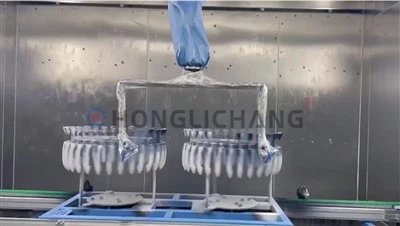
So, what does this mean if you’re running a robot paint plant or looking to upgrade your gear? The drying oven isn’t a secondary piece of equipment—it’s the part that ties your robotic spray arms, your conveyor line, and your paint inventory all together. It’s what makes your yield go up, your costs go down, your robots last longer, and your production speed stay consistent. Skipping on a good drying oven is like buying a high-end sports car and putting cheap gas in it: it’ll run for a little while, but it’ll break down faster and you’ll get way worse performance.
Interior Parts If you’re thinking it’s time to upgrade your drying oven, or you’re setting up a new robot paint plant and want to make sure you spec the right unit, let’s connect. We’ve worked with everything from small 10-spot hobbyist setups to large-scale automotive plants, so we can walk you through what size, type, and features will fit your exact needs, no generic sales pitches. No pressure, just straight talk about what’s going to save you money and keep your plant running smooth.
References
- Society of Manufacturing Engineers (SME). (2022). “Key Process Controls for Automated Paint Curing.” Manufacturing Engineering Journal.
- Automotive Paint & Coating Association (APCA). (2021). “Energy Efficiency in Industrial Drying Ovens.” Industrial Coatings Report.
- Robot Systems Global. (2023). “Maintenance Challenges for Robotic Paint Application Equipment.” Robotic Industry Review.
- Occupational Safety and Health Administration (OSHA). (2020). “Solvent Vapor Ventilation for Paint Processes.” Safety Guidelines for Industrial Facilities.
Shenzhen Honglichang Machinery Manufacturing Co., Ltd.
We are one of the most professional robot paint plant manufacturers and suppliers in China, also support customized service. Please feel free to buy advanced robot paint plant for sale here from our factory. Welcome to contact us for quotation.
Address: No.A802, Building 2, Tianan Digital Plaza, Longgang, Shenzhen, China
E-mail: victor@honglichang.com
WebSite: https://www.honglichang-paint.com/
