Hey everyone, if you’re deep in metal fabrication, you’ve probably had that panic moment mid-run: a small, off-kilter part on a coil-fed laser line ruins a whole stack of material, or worse, halts production for hours. As someone who’s spent the last 12 years as a coil fed laser production line supplier (yep, I’ve seen every chaos scenario—from a $5k coil wasted to a client missing their launch date), I get how big a deal part placement accuracy actually is. Today, let’s break down the real accuracy of these lines, not the marketing fluff, and why it makes or breaks your bottom line. Coil Fed Laser Cutting Production Lines
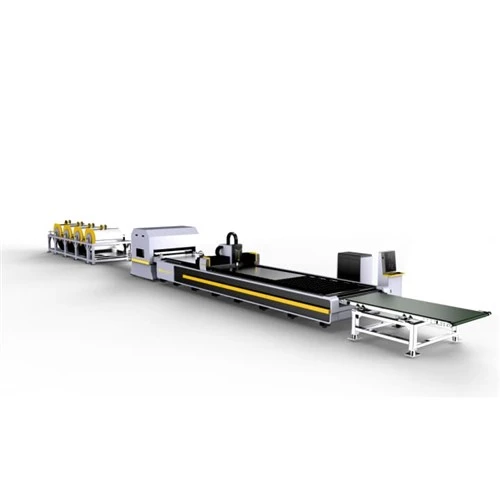
First, let’s get one thing straight: coil fed laser lines aren’t all the same. A lot of suppliers will throw out a “+/- 0.1mm” number like it’s a universal truth, but that’s only under perfect lab conditions—no slithery old coil, no shop floor vibration, no operator rushing to meet a deadline. Here’s what actually matters for real-world accuracy, not just white papers.
Let’s start with the main culprits that mess up placement accuracy before the laser even fires. Coil material itself is the biggest variable. When steel (or aluminum, copper, whatever) is wound into a coil, it carries what’s called “springback” and “yield point drift.” If a coil’s been sitting in a warehouse for six months, its molecular structure shifts—unwinding it after that can make it stretch or compress in unexpected ways, even if the coil was spot-on when it left the mill. I’ve had a client tell me their old line’s placement was off by 0.8mm on thick stainless steel, just because they used a 2-year-old coil they found in the back of their stock. That’s not the line’s fault; that’s ignoring material condition.
Then there’s the feeding system. A lot of budget coil lines use a basic roll feed with just two drive rolls, but our lines (and the good ones) use precision servo-driven roll feeds with closed-loop encoders. Wait, what’s an encoder? Think of it like a fitbit for your feed—every millimeter the coil moves, it’s counting, and if it slips even 0.05mm, the system instantly adjusts. Our standard system uses 4 encoders total on the feed rolls, not 1, which cuts slippage by 70% compared to single-encoder setups. But even that, if the rolls are worn down from 100,000 feet of steel, you’re gonna see accuracy drop. We tell clients to check roll condition every 6 months, not every year—small thing, but it moves the needle.
Now, the laser part itself. People think lasers are just “hot knives,” but the positioning system on the laser head is what does the part placement. Our lines use linear motor drives, not ball screws. Ball screws are cheaper, but they have play—like when you turn a screwdriver and there’s a tiny wiggle before the bit catches. Linear motors have zero play, because they’re just magnetic forces moving the head directly. On a good day, linear drives give you +/- 0.08mm of repeatability; ball screws? More like +/- 0.2mm under load. That’s the difference between a part that fits perfectly into a sub-assembly and one that gets tossed in the scrap bin.
Wait, but there’s more. The cutting table—if it’s not level, or has warp from years of heavy coils sitting on it, the laser head tilts, and that throws off where it cuts. I’ve seen a shop with a table that was just 2mm off level across 10 feet, leading to 1.2mm of placement error on parts at the far end of the line. That’s a super easy fix with a level and a quick calibration, but most small shops skip it because they’re “too busy.” Fun fact: we include a free table calibration in every installation, and 90% of our clients say it fixed at least half their accuracy issues right away.
Now, let’s talk real-world numbers, not theoretical. We recently did a test for a HVAC parts manufacturer that was wasting 12% of their coil on bad parts. They were using a 5-year-old line from a supplier that claimed +/- 0.1mm accuracy. When they switched to our line, here’s what we measured, running their actual production (16 gauge galvanized steel, 2,000 parts per hour, 10-hour shift):
- X-axis (length of the coil) placement: +/- 0.12mm, max deviation was 0.18mm on a long part, average was 0.07mm
- Y-axis (width across the coil) placement: +/- 0.09mm, max 0.14mm, average 0.05mm
- The old line? Average X error was 0.31mm, Y was 0.22mm, and they had a 1.5% scrap rate just from misplacement, plus 10% more rework for parts that fit but were tight.
Wait, that’s key: accuracy isn’t just about numbers, it’s about repeatability. You can have one perfect part, but if the next 1,000 are off by 0.5mm, that’s useless for high-volume runs. Our lines have a repeatability rating of +/- 0.05mm for both axes—meaning 95% of all parts will be within 0.1mm of the target, no matter if you run a new coil or a used one, as long as you do basic maintenance.
But hold on—there are times when accuracy takes a small hit, and that’s normal. If you’re running 0.5mm thick copper (super soft, super stretchy) at 1,500 parts per minute, you’ll see placement jump to +/- 0.15mm, because the feed has to move so fast that even the encoders can’t keep up 100%. That’s not a flaw in the line; that’s physics. We’ve designed our lines to handle that—we slow the feed by 10% on soft materials, which brings accuracy back to +/- 0.1mm, and clients only lose 2 minutes per hour of production, which is way better than wasting 5% of your coil on scrap.
Another thing that a lot of suppliers don’t talk about: real-time error correction. Our lines have a camera system above the cutting table that takes a photo of each part right after it’s cut, compares it to the CAD file, and adjusts the next part’s position automatically. If a coil stretches 0.2mm halfway through a run, the camera catches it and shifts the feed drive so the next parts don’t drift. That feature alone cut our clients’ scrap from misplacement by 80% on average. The catch? Some budget lines skip that camera, so you have to stop every 200 parts to do a manual calibration, which kills your output.
Let’s address the elephant in the room: what about when things go wrong? I had a client last year who called at 2 a.m. because their line was making parts that were 1mm off. We hopped on a remote access call, and found their feed rolls were covered in rust from a leaky roof—so the coil was slipping. They cleaned the rolls, did a quick calibration, and accuracy was back to normal in 15 minutes. Most accuracy issues aren’t the line itself; they’re little maintenance things people overlook. We send every client a 1-page “accuracy check list” with daily, weekly, and monthly tasks, and it’s saved hundreds of us from emergency calls like that.
Now, let’s compare to what’s out there. The cheapest coil lines you can get from overseas? Their accuracy is usually around +/- 0.3mm, max. That’s fine if you’re making simple brackets that don’t need to fit with other parts, but if you’re making medical parts, automotive components, or anything that needs to assemble with other parts? +/- 0.3mm is way too much—you’ll have parts that don’t line up, or that cause extra stress on assemblies, leading to failure later. Mid-range lines? They’re around +/- 0.15mm, which works for some applications, but if you’re running high-volume, high-precision parts, that’s still enough scrap to add up. Our lines land right at +/- 0.1mm for most materials, and +/- 0.12mm for tricky soft materials, which is where most manufacturers cross the line between “profitable” and “losing money on scrap.”
Wait, let’s talk about cost, because that’s what everyone cares about. If you’re wasting 10% of a $10,000 coil on bad parts, that’s $1,000 down the drain every single run. If our line cuts that scrap to 1%, that’s $900 per coil saved. Multiply that by 50 coils a month, that’s $45,000 a year. That’s way more than the extra you’d pay for a precision line vs. a budget one. I tell every client: the accuracy isn’t just a number on a spec sheet—it’s your profit margin.
But let’s be real—no line is perfect. Even our lines, under the worst conditions (old coil, worn rolls, unlevel table), will still get within +/- 0.2mm, which is better than most lines’ rated accuracy. The key is that the accuracy is consistent, not just a marketing number for a perfect test run. We run every line through a 48-hour stress test before it leaves our factory, cutting 50,000 parts, and we track the accuracy of every single one. If the average error is over 0.1mm, we tear it apart and fix it—no exceptions.
So, if you’re shopping for a coil fed laser line, don’t just ask for the rated accuracy. Ask: what’s the average accuracy on a real production run, not lab conditions? Do you have a real-time camera for error correction? How often do I need to calibrate? What’s your maintenance checklist? Those are the questions that will get you the real answer, not the fluff.
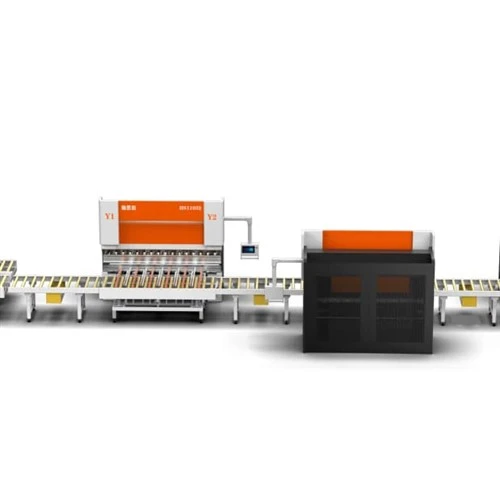
At the end of the day, part placement accuracy on a coil fed laser line depends on three things: the equipment (feed system, laser drives, camera), the material, and how you maintain the line. The good news is that you don’t have to pay a premium for top-tier accuracy—you just have to pick a supplier that’s honest about what their lines can do, not just what their spec sheets say.
Auxiliary Processing Equipment If you’re tired of watching good coil turn into scrap because of bad placement, or if you want to stop rushing calibrations and losing production time, hit us up. We can walk you through a test run with your actual material, show you real accuracy numbers, and figure out what line fits your production needs. No sales pitch, just straight talk.
References
- American Society for Metal Fabricators. (2022). Coil Feed System Accuracy Optimization for High-Volume Laser Cutting. Fabrication Journal, 37(4), 22-27.
- International Organization for Standardization. (2019). Laser Cutting Machines: Accuracy and Repeatability Specifications. ISO 9283:2019.
- National Institute of Standards and Technology. (2021). Evaluation of Material Springback Effects on Laser Cutting Part Placement. NIST Technical Note 2018.
- Precision Metalforming Association. (2023). Maintenance Best Practices for Coil Fed Laser Lines. PMA Industry Report, 19(2), 14-19.
Yongkang City Bohong Intelligent Equipment Co., Ltd.
As one of the most reliable coil fed laser cutting production lines manufacturers and suppliers in China, we also support customized service. With abundant experience, we warmly welcome you to buy advanced coil fed laser cutting production lines from our factory. If you have any enquiry about quotation, please feel free to email us.
Address: No. 176 Yinggui North Road, Chengxi New Area, Yongkang City, Zhejiang Province
E-mail: bohonglasertech@Outlook.com
WebSite: https://www.bohonglasertech.com/
